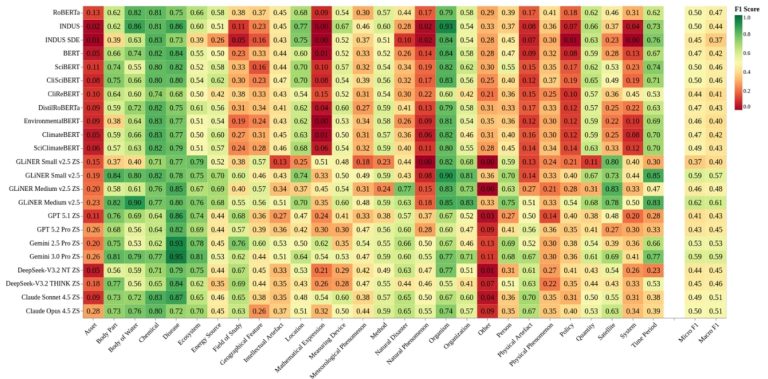
The rapid growth of scientific literature on anthropogenic climate change necessitates automated information extraction to manage and synthesise complex, multi-scalar climate phenomena. Although the research community increasingly relies on natural language processing (NLP), particularly named entity recognition (NER), existing resources in this domain lack broad thematic coverage and rigorous multi-expert validation. To address this gap, we introduce CliReNER, a novel NER resource for climate research literature comprising 28 fine-grained entity types. The resource includes two datasets: CliReNER, an author-annotated dataset, and CliReNER, a high-fidelity benchmark annotated by 12 experts from various scientific backgrounds. We systematically compare CliReNER with existing climate NLP datasets and conduct a comprehensive benchmark across 23 deep neural models, covering fine-tuned encoder models, generalist NER architectures, and zero-shot commercial large language models (LLMs). The results show that fine-tuned generalist NER architectures (GLiNER) and the strongest zero-shot LLM (Gemini 3.0) achieve closely comparable aggregate performance (Aggregated F1 = 0.6371 vs. 0.6282; Table 2), despite Gemini 3.0 never being exposed to the training distribution. For traditional encoder-based models, domain-adapted variants offer a clear advantage. The two top-performing approaches are more clearly distinguished by strict-boundary precision, where GLiNER retains a consistent advantage that cannot be fully separated from gold-annotation boundary conventions, and by deployment cost, where it is several orders of magnitude cheaper at scale. Zero-shot LLMs identify entity types at a rate comparable to fine-tuned models but consistently show larger boundary-error deltas, a gap that few-shot prompting or fine-tuning could plausibly narrow. We release our datasets, guidelines, and fine-tuned models to support advanced knowledge extraction in climate change research.

