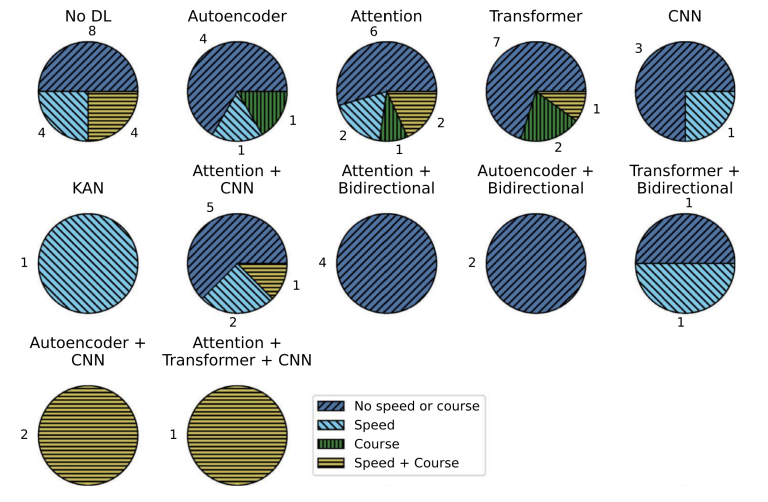
Maritime navigation safety is the basis for global logistics and marine ecosystems. The increasing availability of Automatic Identification System (AIS) data has opened new avenues for forecasting vessel trajectories with higher precision and robustness. This review presents a comprehensive survey of recent data-driven approaches, including probabilistic models, classical statistical methods, and deep learning (DL) architectures. Long Short-Term Memory (LSTM), Gated Recurrent Unit (GRU), Recurrent Neural Network (RNN), Transformer-based models, and hybrid systems are evaluated for maritime trajectory prediction. By categorizing studies based on their input features (speed, course, and position) and computational methods, this review highlights methodological trends and performance benchmarks. Additionally, an overview of dataset accessibility and contextual variable use, including weather and wave state, is presented to support future reproducibility. We conclude by identifying gaps and future directions toward explainable and adaptive maritime forecasting systems.