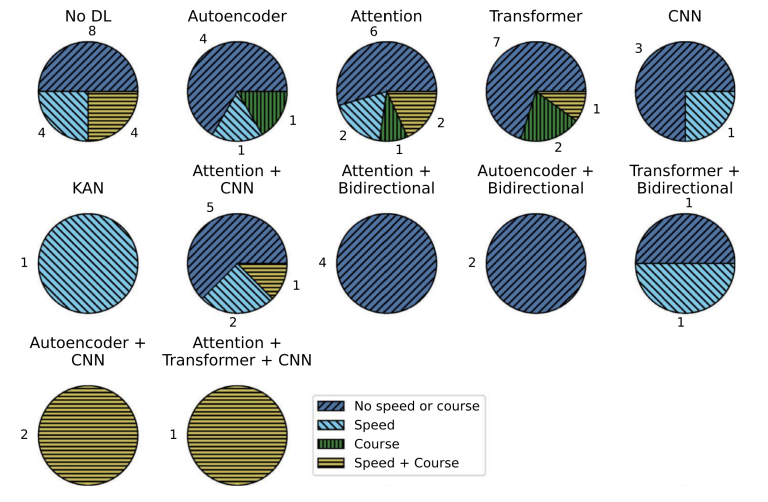
Maritime navigation safety is the basis for global logistics and marine ecosystems. The increasing availability of Automatic Identification System (AIS) data has opened new avenues for forecasting vessel trajectories with higher precision and robustness. This review presents a comprehensive survey of recent data-driven approaches, including probabilistic models, classical statistical methods, and deep learning (DL) architectures. […]
Research Papers
Hybrid Deep Learning Models for Medium-Term Electricity Load Forecasting
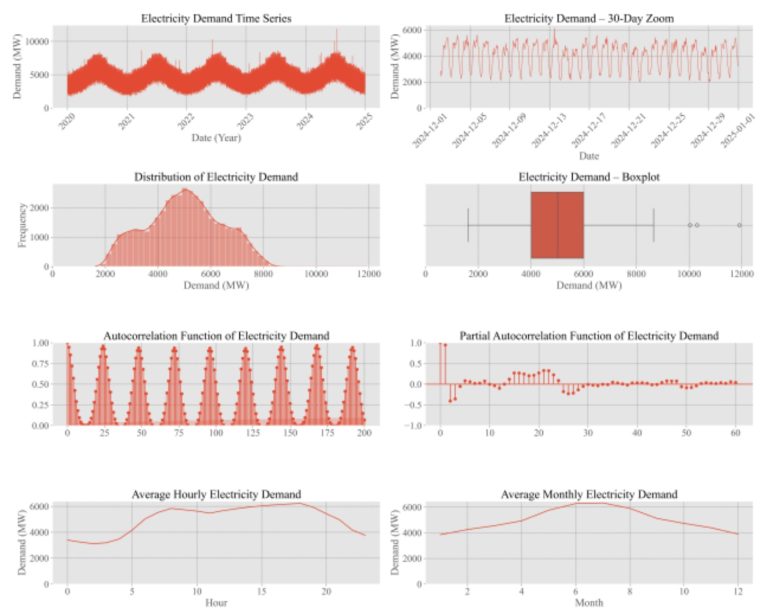
This paper presents a hybrid model for medium- and long-term electricity demand forecasting, developed with the aim of achieving accurate forecasts on horizons ranging from a few weeks to several months. Univariate deep models show a significant drop in performance at higher time horizons and are unable to adequately model long-term nonlinearities and changes in […]
Machine Learning for Ship-Motion-Based Sea-State Estimation
Sea-state estimation (SSE) supports safe, efficient, and autonomous maritime operation. Conventional sources, including wave buoys, satellites, radar systems, and metocean products, are valuable but cannot provide continuous, local estimates. Ship-motion-based SSE offers a complementary solution by using the vessel as a wave-sensing platform through the wave buoy analogy (WBA). This review examines machine-learning (ML) approaches […]
Security and Privacy of Large Language Models: Threat Taxonomy, Ethical Implications, and Governance
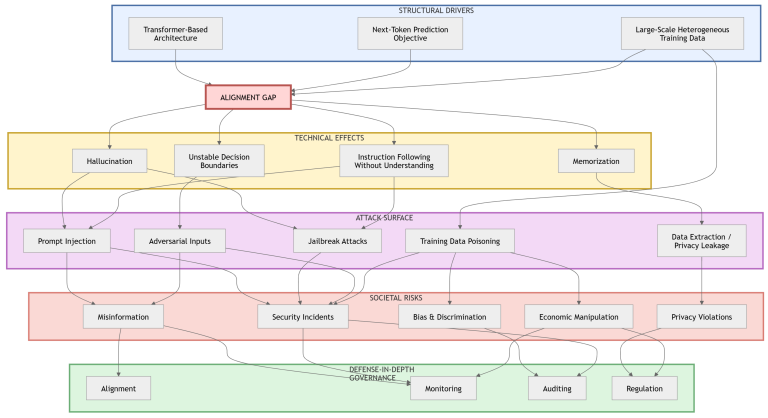
Large Language Models (LLMs) are increasingly deployed across professional and societal domains, introducing security, privacy, and governance challenges beyond traditional software vulnerabilities. Despite extensive research on individual risk categories, a unified lifecycle-oriented perspective connecting architectural properties, adversarial threats, and governance implications remains limited. This review examines security and privacy risks associated with LLMs through a […]
Deep Unfolding ADMM Network for CS Image Reconstruction with Long-Short Term Residuals
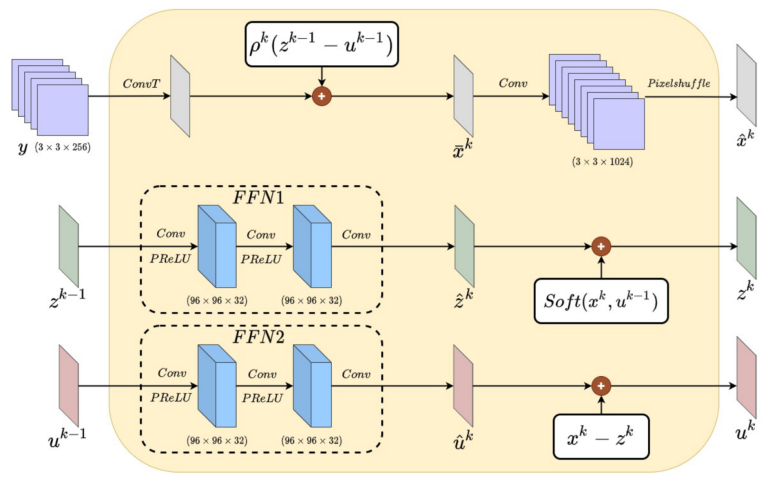
Deep learning has demonstrated exceptional learning capabilities, leading to the development various deep unfolding networks for image reconstruction. However, current deep unfolding networks often replace certain steps of traditional optimization algorithms with neural networks, thereby compromising the interpretability of the optimization algorithms. Additionally, each iteration in the unfolding process may result in certain image information […]
XDT-FMARL: An Explainable Federated Multi-Agent Reinforcement Learning Framework for Energy-Efficient IoT Task Offloading
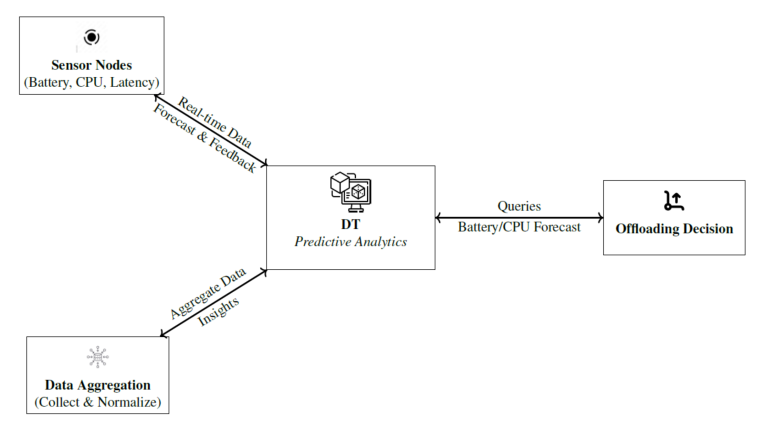
Effectively managing the vast data generated by sensor networks has become crucial with the rapid spread of IoT devices under strict resource constraints. This research introduces a framework that integrates explainable artificial intelligence (XAI), digital twins (DT), federated learning (FL), and multi-agent reinforcement learning (MARL) to optimise energy use and task distribution in distributed IoT […]
Proactive Context Aware Task Offloading in Digital Twin Driven Federated IoT Systems with Large Language Models
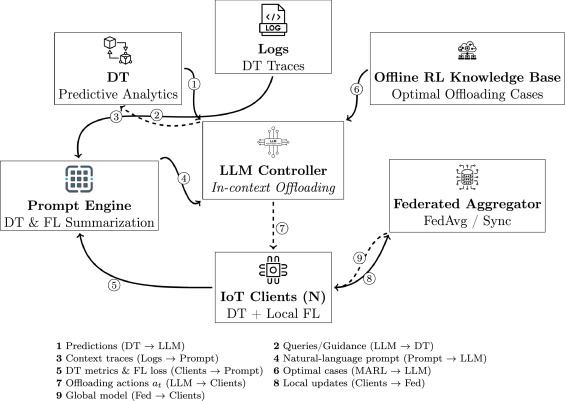
This study considers the combination of Digital Twins (DT), Federated Learning (FL), and computation offloading to establish a context-aware framework for effective resource management in IoT networks. Although DT models can predict battery levels, CPU usage, and network delays to aid reinforcement learning (RL) agents, earlier RL-based controllers require significant training and are slow to […]
Pretraining and evaluation of BERT models for climate research
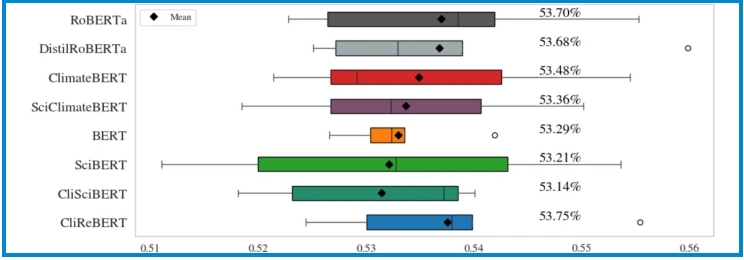
Motivated by the pressing issue of climate change and the growing volume of data, we pretrain three new language models using climate change research papers published in top-tier journals. Adaptation of existing domain-specific models based on Bidirectional Encoder Representations from Transformers (BERT) architecture is utilized for CliSciBERT (domain adaptation of SciBERT) and SciClimateBERT (domain adaptation […]
Digital Twin-Driven Federated Learning and Reinforcement Learning-Based Offloading for Energy-Efficient Distributed Intelligence in IoT Networks
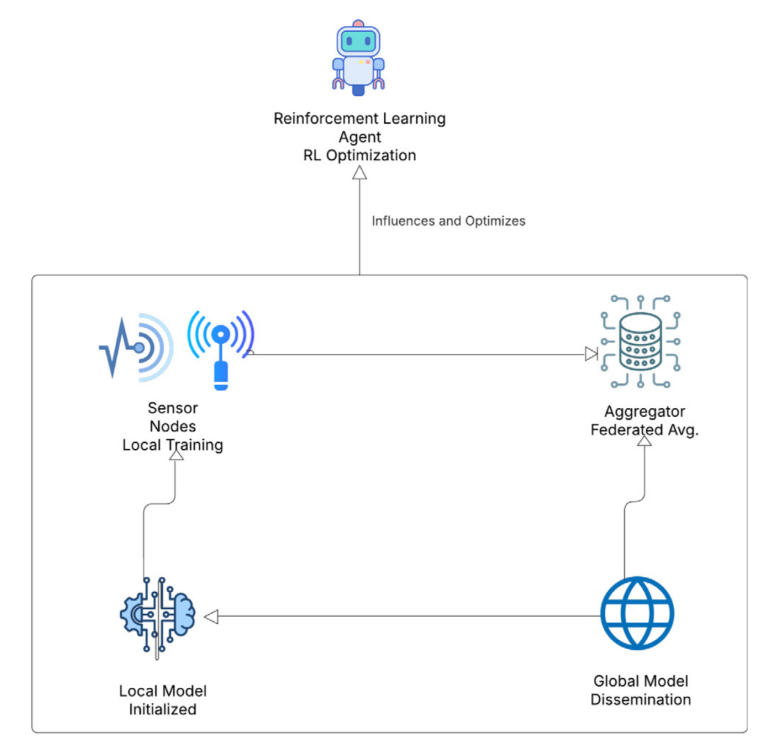
Improved frameworks for delivering both intelligence and effectiveness under strict constraints on resources are required due to the Internet of Things’ (IoT) devices’ rapid expansion and the resulting increase in sensor-generated data. In response, this research considers a joint learning-offloading optimization approach and presents an improved framework for energy-efficient distributed intelligence in sensor networks. Our […]
Forecasting the Trajectory of Personal Watercrafts Using Models Based on Recurrent Neural Networks
Monitoring and predicting personal watercraft trajectories is a novel and largely unexplored research area where any development is valuable for various rental services. Unlike existing work focused on specific maritime routes, this study introduces a location-agnostic deep-learning approach capable of generalizing across diverse environments. This is achieved by using an innovative preprocessing approach including offset […]