• Skip to primary navigation
  • Skip to main content
  • Skip to primary sidebar
  • Skip to footer

Center for Artificial Intelligence and Cybersecurity – AIRI

  • Home
  • About Us
    • Center Activities
    • Vision, Mission and Goals
    • Center Faculty
    • Steering Committee
    • Press
  • Research
    • Scientific Projects
    • Research Papers
  • Laboratories
    • Machine Learning
    • Natural Speech & Language Processing
    • Blockchain Technology
    • Information Processing & Pattern Recognition
    • AI in Medicine
    • Data Mining
    • Computer Vision
    • Complex Networks
    • Human-Computer Interaction
    • Maritime Cybersecurity
    • Autonomous Navigation
    • AI in Mechatronics
    • AI in Education
    • Hybrid Computational Methods
    • Drug Design
    • Legal Aspects of AI
    • Ethically Aligned AI
    • Cultural Complexity
    • Trustworthy and Explainable AI
  • Collaboration
    • Industry Collaboration
    • Industry Projects
    • International Collaboration
  • News
  • Contact
  • Login

Deep Unfolding ADMM Network for CS Image Reconstruction with Long-Short Term Residuals

22.12.2025

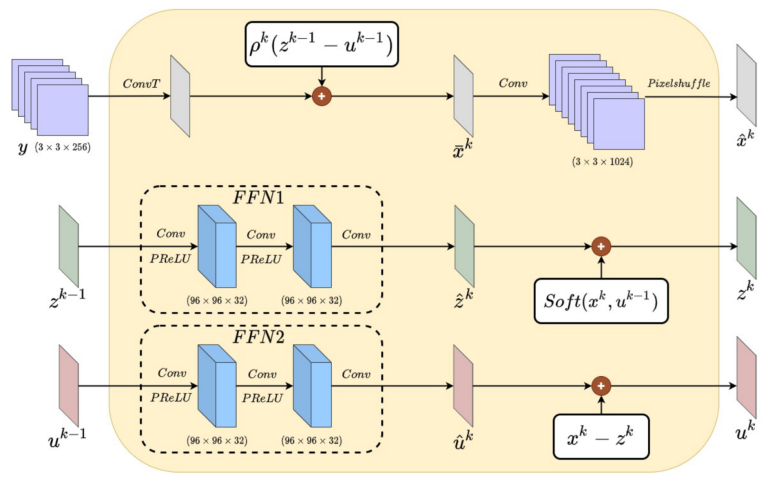
Deep learning has demonstrated exceptional learning capabilities, leading to the development various deep unfolding networks for image reconstruction. However, current deep unfolding networks often replace certain steps of traditional optimization algorithms with neural networks, thereby compromising the interpretability of the optimization algorithms. Additionally, each iteration in the unfolding process may result in certain image information loss, negatively impacting image reconstruction quality. This paper proposes a deep unfolding Alternating Direction Method of Multipliers (ADMM) network named LSRA-CSNet for compressive sensing image reconstruction, incorporating a long-short term residual optimization mechanism. The LSRA-CSNet is constructed by stacking multiple stages, with each stage consisting of a Fast ADMM Block (FAB) and a Residual Optimization Block (ROB). In FAB, inspired by the Woodbury matrix identity, we propose a fast version of the ADMM algorithm. Meanwhile, instead of replacing certain steps of the ADMM with neural networks, we leverage CNNs to replace some matrix operations. ROB consists of the Short-Term Residual Refinement Module (SRRM) and the Long-Term Residual Feedback Module (LRFM), which optimize the reconstruction details by leveraging inter-stage image residuals and multi-stage measurement residuals, respectively. Experiments on four datasets show the effectiveness of LSRA-CSNet, demonstrating superior reconstruction accuracy compared to existing CS image reconstruction networks.

Authors:
Junpeng Hao, Huang Bai, Xiumei Li, Jonatan Lerga, Junmei Sun
Journal:
Signal Processing
Publishing date:
22.12.2025
View original article

Primary Sidebar

Latest Projects

Advanced Data Analysis Using Digital Signal Processing and Machine Learning Techniques

Compound Flooding in Coastal Rivers in Present and Future Climate

Data Processing on Graphs

North Adriatic Hydrogen Valley

Data Governance and Intellectual Property Governance in Common European Data Spaces – DGIP-CEDS

Latest Research Papers

Deep Unfolding ADMM Network for CS Image Reconstruction with Long-Short Term Residuals

XDT-FMARL: An Explainable Federated Multi-Agent Reinforcement Learning Framework for Energy-Efficient IoT Task Offloading

Proactive Context Aware Task Offloading in Digital Twin Driven Federated IoT Systems with Large Language Models

Pretraining and evaluation of BERT models for climate research

Digital Twin-Driven Federated Learning and Reinforcement Learning-Based Offloading for Energy-Efficient Distributed Intelligence in IoT Networks

Latest News

Pretraining and evaluation of BERT models for climate research

Invited lecture: “About the first GPS receiver on the Moon, and the other NASA space PNT stories” by James J. Miller (NASA)

Agreement on collaboration between the Faculty of Engineering in Rijeka and the Shanghai Artificial Intelligence Research Institute

Arian Skoki defended his doctoral thesis “Data-Driven Assessment of Player Performance and Recovery in Soccer”

Anna Maria Mihel defended her PhD dissertation topic

We provide the expertise for solving real world problems using AI

If your company wants to implement artificial intelligence in your products or services, or increase your level of cybersecurity, our multidisciplinary team of scientists is your ideal partner.

Contact us

Footer

Center for Artificial Intelligence and Cybersecurity
  • jlerga@airi.uniri.hr
  • +385 51 406 500

University of Rijeka

University of Rijeka

About the Center

  • About Us
  • News
  • Privacy Policy
  • Contact

Center Activities

  • Laboratories
  • Scientific Projects
  • Industry Projects
  • Research Papers
  • Industry Collaboration
  • International Collaboration

Footer bottom left

© 2020 Center for Artificial Intelligence and Cybersecurity, all rights reserved.

Designed & developed by Nela Dunato Art & Design