• Skip to primary navigation
  • Skip to main content
  • Skip to primary sidebar
  • Skip to footer

Center for Artificial Intelligence and Cybersecurity – AIRI

  • Home
  • About Us
    • Center Activities
    • Vision, Mission and Goals
    • Center Faculty
    • Steering Committee
    • Press
  • Research
    • Scientific Projects
    • Research Papers
  • Laboratories
    • Machine Learning
    • Natural Speech & Language Processing
    • Blockchain Technology
    • Information Processing & Pattern Recognition
    • AI in Medicine
    • Data Mining
    • Computer Vision
    • Complex Networks
    • Human-Computer Interaction
    • Maritime Cybersecurity
    • Autonomous Navigation
    • AI in Mechatronics
    • AI in Education
    • Hybrid Computational Methods
    • Drug Design
    • Legal Aspects of AI
    • Ethically Aligned AI
    • Cultural Complexity
    • Trustworthy and Explainable AI
  • Collaboration
    • Industry Collaboration
    • Industry Projects
    • International Collaboration
  • News
  • Contact
  • Login

Predicting Anomalous Trajectories Using Machine Learning

06.03.2026

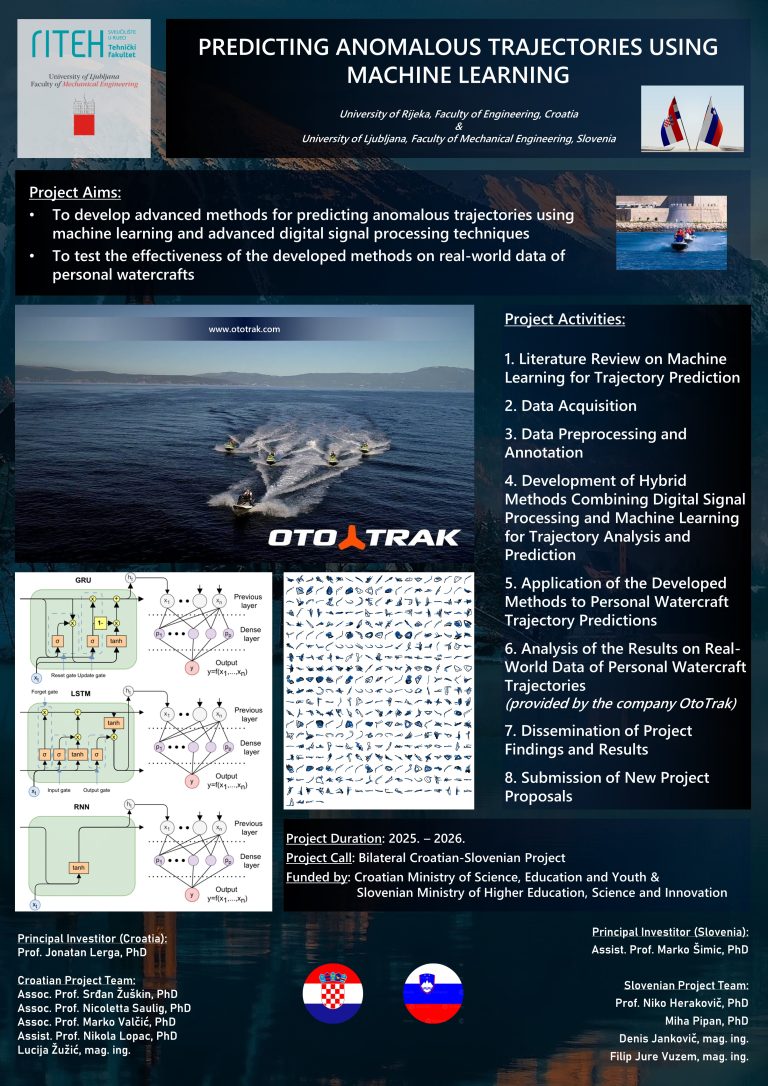
The proposed project focuses on applying machine learning to predict future trajectories, i.e., geographic position, using as input the changes in longitude and latitude, speed, and heading. Trajectories are classified based on inflection points present in the functions representing segments of the trajectories. Since the developed algorithms are intended for real-world data, preprocessing is planned. Trajectories with excessively large time gaps between received values of the required variables are removed. Geometric transformations and timestamp conversion are then applied so that trajectories from different geographic areas, as well as those with different start dates and times, can be processed together.

The planned research includes the following steps:

  • Preprocessing input trajectories of jet skis and/or boats (non-stationary time series), especially real-world data where unexpectedly large gaps between records occur. Translation, rotation and/or mirroring will be applied to map all trajectories into the first quadrant of the Cartesian coordinate system. Instead of time and date, the offset in milliseconds from the timestamp of the first point in the trajectory will be used.
  • Designing a new method for characterizing (i.e., classifying) trajectory segments based on the inflection points of the function representing a segment of the trajectory.
  • Conducting a human-labeling experiment on similar trajectories to compare the proposed algorithm with human judgment of trajectory similarity and class membership.
  • Segmenting trajectories and analyzing the variables that jointly form a trajectory using machine learning, i.e., recurrent neural network models with GRU and LSTM layers and attention mechanisms.
  • Reconstructing trajectories from predictions of time-series values of variables such as longitude and latitude, or heading, speed, and the time interval between consecutive records in a trajectory.
  • Validating the proposed machine-learning-based procedures on real-world jet ski and/or boat trajectories.

Duration:
2026–2027
Contributors:
Jonatan Lerga, Marko Šimic, Srđan Žuškin, Nikola Lopac, Nicoletta Saulig, Nino Krvavica, Marko Valčić, Niko Herakovič, Miha Pipan, Denis Jankovič, Filip Jure Vezum

Primary Sidebar

Latest Projects

Predicting Anomalous Trajectories Using Machine Learning

Adaptive Algorithms for Integrating Compressive Sensing with Deep Learning

Deep Learning for Smart Energy Systems Management

Advanced Data Analysis Using Digital Signal Processing and Machine Learning Techniques

Compound Flooding in Coastal Rivers in Present and Future Climate

Latest Research Papers

Deep Unfolding ADMM Network for CS Image Reconstruction with Long-Short Term Residuals

XDT-FMARL: An Explainable Federated Multi-Agent Reinforcement Learning Framework for Energy-Efficient IoT Task Offloading

Proactive Context Aware Task Offloading in Digital Twin Driven Federated IoT Systems with Large Language Models

Pretraining and evaluation of BERT models for climate research

Digital Twin-Driven Federated Learning and Reinforcement Learning-Based Offloading for Energy-Efficient Distributed Intelligence in IoT Networks

Latest News

LIVE Quantum project kick-off meeting

Pretraining and evaluation of BERT models for climate research

Invited lecture: “About the first GPS receiver on the Moon, and the other NASA space PNT stories” by James J. Miller (NASA)

Agreement on collaboration between the Faculty of Engineering in Rijeka and the Shanghai Artificial Intelligence Research Institute

Arian Skoki defended his doctoral thesis “Data-Driven Assessment of Player Performance and Recovery in Soccer”

We provide the expertise for solving real world problems using AI

If your company wants to implement artificial intelligence in your products or services, or increase your level of cybersecurity, our multidisciplinary team of scientists is your ideal partner.

Contact us

Footer

Center for Artificial Intelligence and Cybersecurity
  • jlerga@airi.uniri.hr
  • +385 51 406 500

University of Rijeka

University of Rijeka

About the Center

  • About Us
  • News
  • Privacy Policy
  • Contact

Center Activities

  • Laboratories
  • Scientific Projects
  • Industry Projects
  • Research Papers
  • Industry Collaboration
  • International Collaboration

Footer bottom left

© 2020 Center for Artificial Intelligence and Cybersecurity, all rights reserved.

Designed & developed by Nela Dunato Art & Design